Korean crypto forums have gone unusually quiet this summer. A popular reading treats that silence as a buy signal. Assets bottom when nobody is left to sell, the argument runs, so a market nobody is arguing about is a market that has already been cleared out. Korean traders, on this reading, have simply finished selling.
Because that silence can be measured rather than inferred, the reading is worth testing before it is accepted. The kimchi premium tracks how much more Koreans pay for bitcoin than everyone else does, computed from the Upbit price converted at the day’s exchange rate and compared against Binance in dollars. We rebuilt that premium daily back to January 1. The series does not support the tidy version of events, and Korean demand did not fade slowly the way a long grind lower would suggest.
The quiet started in May, not January
For most of the first four months of this year, Korean demand was healthy. The January premium averaged 1.08%, with thirty of its thirty-one days above the line. February ran hotter at 1.81% without a single negative session. Then March wobbled into a flat finish, seventeen positive days out of thirty-one, before April steadied at 0.46%. Taken together, 100 of those 120 sessions closed positive.
May breaks the pattern at minus 0.32%, with only eleven days above the line. June goes uniformly negative, averaging minus 1.51% with not one positive day in thirty. July held at minus 1.25%, managing two. So far August has produced four out of twenty-one.
Those dates matter. The bottom-signal reading rests on a picture of sellers exhausting themselves slowly over a year, and the series traces nothing of the kind. Korean buyers stepped back across a few weeks in late spring and have not stepped forward since.
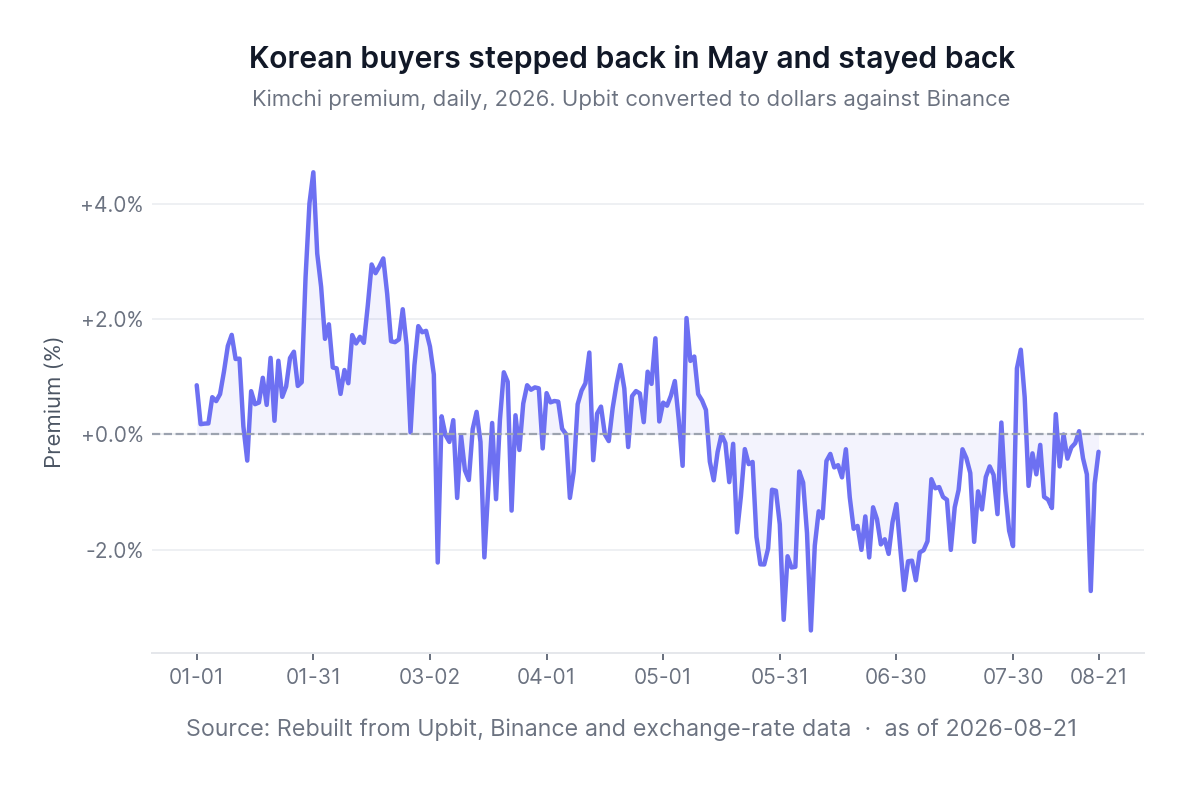
Positive across most of January to April. Negative in every month after.
Four short interruptions break the run below zero. An isolated day on July 27 comes first, then three consecutive sessions from July 31, then single days on August 10 and August 16. Six positive readings in total since July began.
The stocks they moved into
Most of the money that left crypto in May went into Korean equities, where the weeks that followed should have been more than enough to send at least part of it straight back. The Korean stock market fell apart instead.
July closed the Kospi down 22.2%, its worst month in years. By the end of it the index sat nearly 30% below the peak it had set in June. SK Hynix, the semiconductor name that had driven the preceding rally, fell 35.2% over those same weeks. Measured from its June intraday high above 2.98 million won, the stock now sits around 1.7 million, more than 40% below that high.
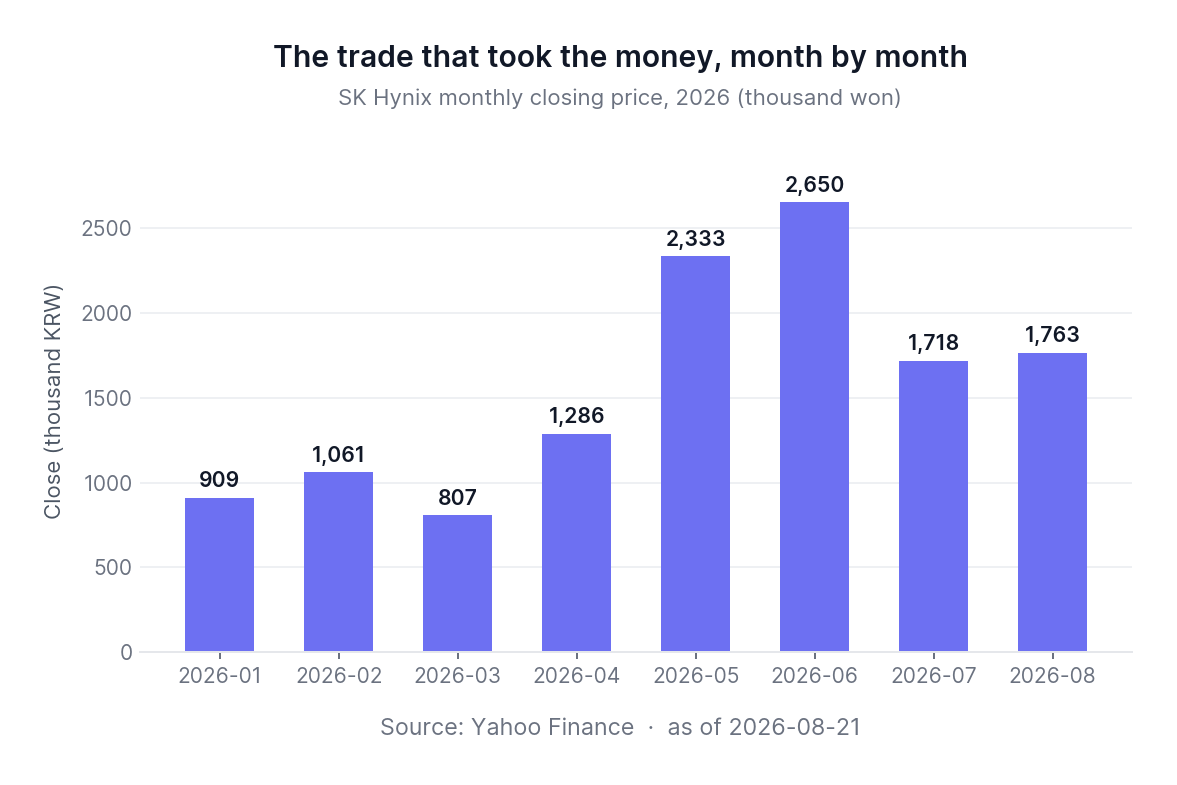
Eight monthly closes, January through August.
March is the only month in that series to fall before the June peak, which is what makes the shape of the reversal so abrupt. July alone handed back a little over half of everything the stock had gained since January.
Almost all of the reporting on Korea’s exit from crypto was written before that collapse, which is why the version most readers encountered still ends on a rising note. The story told through midsummer, retail money rotating from coins into an artificial intelligence semiconductor boom, described the trade accurately while it was working. Local crypto turnover was down 89% year on year at the time, against a Kospi that had more than doubled over twelve months. What no one writing in July could know was how badly the semiconductor trade would end.
Now consider what should have followed such an ending. A stock market that falls 22% in a month usually sends Korean capital looking for a different home. Korean traders in particular have a long record of moving quickly between equities and bitcoin. The premium is precisely the instrument that would register such a move.
What it registered in July was two positive days. Bitcoin has since climbed about 18% inside a week. Historically that is the sort of move that pulls Korean retail back in a hurry, yet August has yielded only four positive sessions out of twenty-one.
Two explanations fit the data equally well. Capital may be trapped in semiconductor positions too far underwater to rotate out of, or the appetite for crypto specifically may not have recovered. Nothing we track separates those cleanly. Both point the same direction for anyone trying to read this rally: Korean demand is not in it.
Who is buying, then
American funds are the obvious candidate. Their flows are real enough. US spot bitcoin ETFs took in $517 million on August 19. Across the four sessions beginning August 17 the total came to roughly $1.1 billion.
The American spot market tells a stranger story. Our Coinbase premium series, built the same way from Coinbase and Binance daily closes, has not printed a positive day since May 5, which is 108 consecutive sessions below the line. It has recovered from around minus 0.11% in mid-August to somewhere near minus 0.02% to minus 0.03% now, most of the distance but not the last step.
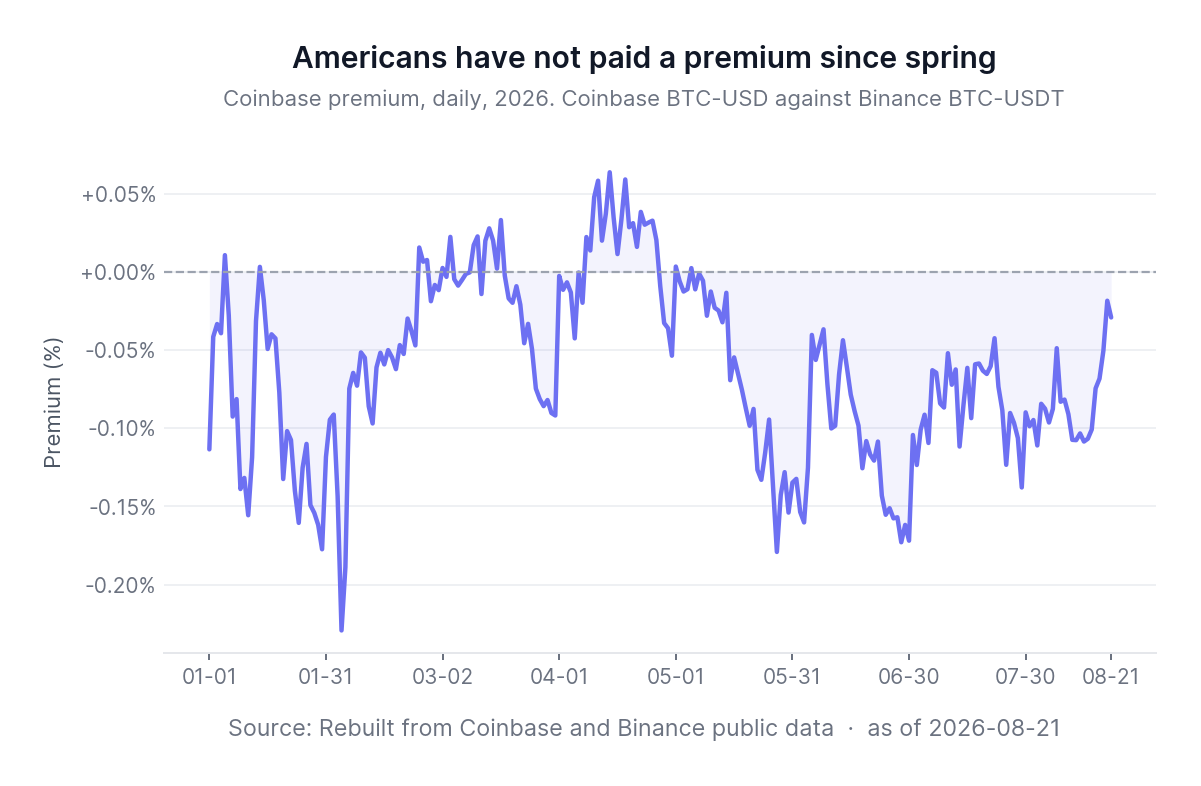
The last point above zero sits in early May.
The right edge of that series is the part worth returning to each morning. It climbs steeply through the past week and then flattens just underneath the line without crossing it.
Derivatives fill the remaining gap. Over the preceding twenty-four hours, $1.02 billion in leveraged positions were force-closed. Shorts accounted for $647 million of that, so roughly two-thirds of the damage fell on traders who had bet against the move.
An 18% week has therefore been assembled from fund creations and a short squeeze, with two retail premiums that never turned positive on either side of it. None of that makes the price less real, though it does mean that the buying standing behind bitcoin this week is a good deal narrower than the weekly number would lead anyone to assume.
Two things worth watching
Both of the missing premiums carry a published daily number, which means neither of them requires any interpretation to read.
Korean money returning would show up as a kimchi premium above zero that stays there. Six positive days since the start of July is not that.
American spot buyers returning would show up as a Coinbase premium holding above parity for several sessions. It has approached the line twice this month and turned back both times.
Korean traders did leave bitcoin for semiconductors, semiconductors then gave back more than 40% from their June peak, and the money has stayed away from both. Whatever pulled it out of crypto in May has outlasted the reason usually given for it. Until one of those two premiums turns, this rally is being carried by funds and forced buying rather than by anyone choosing to own the asset.
Data: kimchi premium and Coinbase premium series rebuilt daily from Upbit, Binance, Coinbase and exchange-rate data. ETF flows and liquidations via coinugget.com/etf and coinugget.com/liquidations, captured in a single snapshot. Kospi and SK Hynix prices via Yahoo Finance. Korean turnover figures via Korea JoongAng Daily and CryptoBriefing. Captured 2026-08-21.