The most watched price in the American financial system is probably not gold, not the S&P, and not bitcoin. It is likely the yield on the ten-year US Treasury note. Thirty-year fixed mortgages, investment-grade paper, credit-card revolvers, and auto loans all price back to that single ten-year yield, roughly and directly. Push the ten-year yield above five percent and real-economy financing typically freezes on contact. That is why the Treasury Secretary, whoever holds the seat, tends to defend that same five-percent line the same way, no matter which party sent them there.
The five-percent line no Treasury can cross
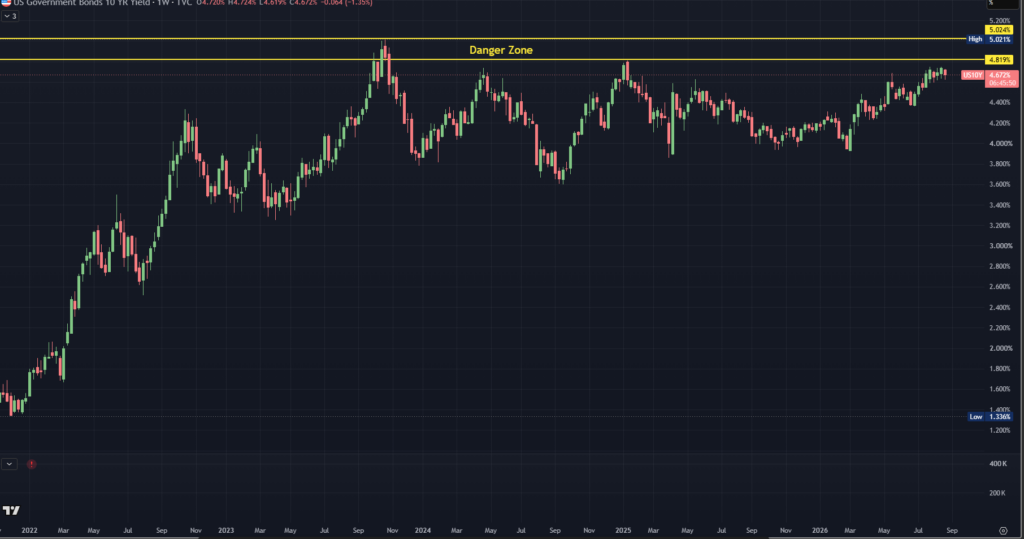
That five-percent line on the ten-year yield is not an academic ceiling. The ten-year over the last four years traces a specific geometry around it. Every rally in the ten-year since 2022 has stalled in roughly the same neighborhood, and every attempt to break through five percent cleanly has been answered within weeks by some Treasury or Fed intervention that reset the tape. The five-percent band is not a random round number. It is where the pipe from Treasury issuance into the real economy generally starts to seize.
The mechanism behind that five-percent line is not sentimental. The Federal Reserve may print dollars without congressional approval to pay itself back, so its reverse repo facility (RRP) is functionally risk-free for money market funds. Treasury bills carry a small debt-ceiling risk, so those Treasury bills generally need to pay a bit more than RRP to pull cash off the Fed’s window. That RRP-to-bills pipe is the plumbing under the ten-year yield. Everything downstream, from mortgage originations to leveraged buyouts, is priced off what flows through that RRP-to-bills pipe. When the ten-year yield starts to look like it might break five percent, that same Treasury does not politely wait for the Fed to help.
The last $2.4 trillion drain, in plain sight
Treasury did not wait between late 2023 and early 2025. That is when the RRP balance fell from about $2.5 trillion to roughly $100 billion. The $2.4 trillion drained out of RRP did not vanish. It rotated out of the Fed’s parking garage and into Treasury bills, which Treasury issued in unusually heavy size for a period when the deficit was running hot. The money that bought those bills traces back to pandemic-era stimulus deposits still sitting inside money market funds. In effect, prior fiscal money that had been quarantined got re-hosed into the private sector, without a single new Fed dot changing.
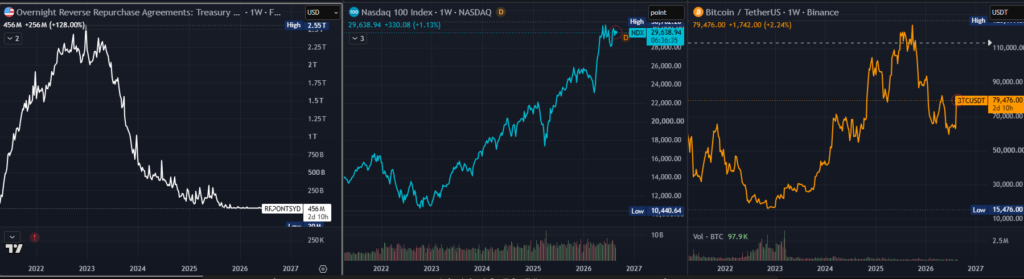
During that RRP drain window, four price series moved in tight lockstep. Nasdaq climbed roughly in step with the RRP drawdown. Bitcoin marched alongside Nasdaq during that same RRP drain. The ten-year yield, which had been probing five percent, backed off and stayed off. Meanwhile the Fed funds rate held near five and a quarter, and quantitative tightening ran quietly in the background. Under the textbook reading, those asset prices should have suffered given that Fed stance. They did not, because the flow that actually mattered ran through Treasury bills and RRP, not through the front door of Fed policy. That same off-door plumbing pattern is what the successor Treasury has now picked up.
A twenty-billion surprise that meant much more
The successor Treasury Secretary inherited that same ten-year yield problem and reached for a variant of that same plumbing. In August that successor Treasury announced that next quarter’s buy back of long-end bonds would be doubled, an extra twenty billion added to the standing buy back program. Against national debt north of forty trillion, twenty billion is a rounding error. The tape still reacted violently within hours of that twenty-billion buy back headline.
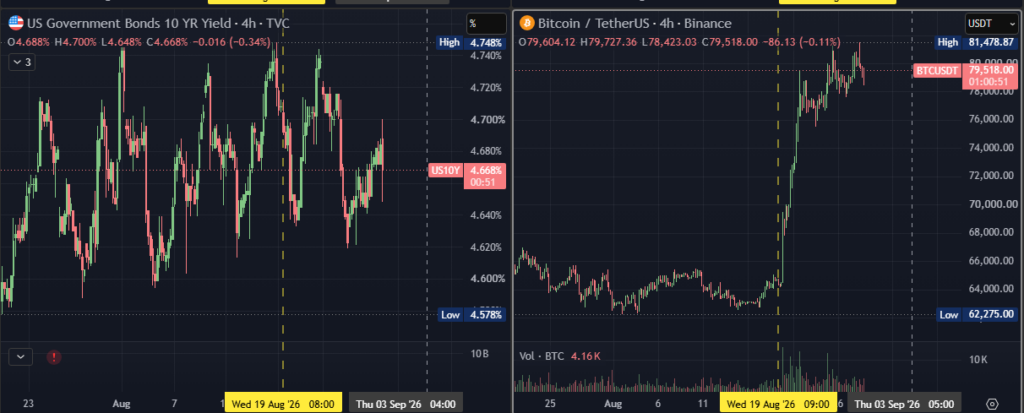
Yields fell, bitcoin popped for two sessions after the buy back announcement, and by the weekly close the ten-year had punched back above the pre-announcement print. Three things happened at once around that twenty-billion surprise. First, traders read the buy back doubling as an admission that the current Treasury office is watching the ten-year with the same anxiety the prior Treasury did. Second, a few weeks earlier that same Treasury office had quietly removed the cap on the FIMA facility, the pipe through which foreign central banks pledge Treasuries at the Fed for dollar loans. Sophisticated desks likely logged that FIMA move as a panic-tell. Third, the market believes whoever sits in that Treasury seat can eventually be forced into far larger interventions, so twenty billion appears to be priced as a first ping rather than the whole buy back play.
The lever list from here
If that twenty-billion buy back is the first ping, only three real Treasury levers exist for what comes next when the ten-year yield presses five percent again. The politically clean lever, cutting federal spending into an election year, is essentially off the shelf. The nuclear lever, BOJ-style unlimited long-bond buying, likely only opens if the ten-year decisively breaks five percent. The middle lever, which is probably where these Treasury moves are heading, is to keep enlarging those Treasury buy backs incrementally until either the MOVE index climbs above roughly 130 or a yield spike forces a bigger hand.
The obvious extension of that middle buy back lever, already telegraphed on the wire, is to drain roughly a trillion dollars out of the Treasury General Account. That Treasury General Account sits at the Fed, so spending the TGA down is mathematically identical to a reserves injection, without requiring the Fed itself to buy a bond. A TGA drain is buy-back financing without calling it that. A straight Fed rate cut plus open-ended QE would clear the ten-year yield problem in a week, and yet those direct Fed moves will not happen for a while. Affordability tops every voter survey in the country. Even a teenager on TikTok can trace the line from Fed rate cuts to grocery inflation. The prior Treasury ran into that same voter wall and answered it with off-balance-sheet plumbing rather than direct Fed help. The current Treasury inherits that same wall, that same plumbing, and the political price of using either honestly.
What bitcoin is actually pricing
Bitcoin’s two-day rip after that August buy back headline, followed by a quick give-back, is not confused positioning. It appears more like a fire alarm test on that same Treasury plumbing. Bitcoin trades global dollar liquidity more cleanly than any listed instrument, and when that Treasury office signals it will fight the ten-year yield with quiet plumbing rather than fiscal restraint, bitcoin is often the first cash register to ring. Whether the next Treasury drain arrives as a bigger buy back, a TGA drawdown, or some other obscure plumbing tweak, the direction of that bitcoin trade generally does not change. What likely does change is the variance around that bitcoin trade.
Two lessons follow from that bitcoin setup and this Treasury lever list. Sit in bitcoin. Do not touch leverage on that bitcoin position. The path for bitcoin stays up as long as the ten-year yield keeps being defended with plumbing rather than restraint. The tape between here and there is likely going to be uglier than that bitcoin path has been.
Data & Sources
US ten-year Treasury yield and RRP balance sourced from Federal Reserve H.15 and H.4.1 releases. Buy back figures cross-checked against Treasury’s Quarterly Refunding Statement dated August 2026. Nasdaq and bitcoin price series from public exchange feeds. TGA balance from the Daily Treasury Statement.